
Translocation and Reintroduction of Great Apes
The process of reintroducing great apes may be long, complex, expensive and often fraught with pitfalls. To assist current and future reintroduction projects, the Primate Specialist Group produced these guidelines, designed to provide a framework of simple, practical standards for wildlife professionals working with great ape reintroduction.
Although IUCN has established working protocols for plant and animal reintroduction, the great apes present unique challenges and concerns owing to their singular cognitive development. This prompted the Primate Specialist Group to reconsider the existing guidelines in terms of the specific needs of great apes. The resulting synthesis, representing the expert opinion of primatologists and reintroduction practitioners, is presented here as part of the series of best-practices documents.
Specifically designed for rehabilitators and specialists in reintroduction, these guidelines start from the fundamental assumption that reintroductions should not endanger wild populations of great apes or the ecosystems they inhabit. Equally important is the health and welfare of the individual great apes being reintroduced, as well as the caretaker staff and the residents of the surrounding areas. The reintroduction guidelines also require that the factors which first threatened great apes in the proposed site of release have been addressed and resolved.
For all great ape individuals being considered for reintroduction, the guidelines recommend extensive medical screenings, to protect both the reintroduced individuals and any wild apes they may interact with. Once reintroduced, the apes must be closely monitored for at least a year – a challenge in itself, given the apes’ size, strength and ranging behaviour. This document addresses this and other issues in detail, and the Primate Specialist Group recommends that these guidelines be implemented by all groups and programmes planning great ape reintroduction.
An amendment to the guidelines for orangutan translocation/reintroduction was agreed in 2015:
AMENDMENT to the guidelines for translocation/reintroduction of orangutans, April 2015, download here: PDF
PDFs of the great reintroduction (translocation) guidelines are available in English, French and Bahasa Indonesia:
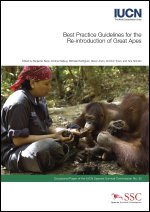
English Best Practice Guidelines for the Reintroduction of Great Apes
Citation: Beck, B., Walkup, K., Rodrigues, M., Unwin, S., Travis, D. and Stoinski, T. 2007. Best Practice Guidelines for the Re-introduction of Great Apes. IUCN SSC Primate Specialist Group, Gland, Switzerland.
Français Lignes directrices pour de meilleures pratiques en matière de réintroduction des grands singes
Citation: Beck, B., Walkup, K., Rodrigues, M., Unwin, S., Travis, D. et Stoinski, T. (2007). Lignes directrices pour de meilleures pratiques en matière de réintroduction des grands singes. Groupe de spécialistes des primates de la CSE UICN, Gland, Suisse
Bahasa Indonesia Panduan Reintroduksi Kera Besar
Citation: Beck, B., Walkup, K., Rodrigues, M., Unwin, S., Travis, D. dan Stoinski, T. (2009). Panduan Re-introduksi Kera Besar. IUCN SSC Primate Specialist Group, Gland, Switzerland.
To request a paper copy of these guidelines, please contact Jill Lucena at jlucena@rewild.org
Reintroduction and translocation during a pandemic
We recommend that no reintroduction or translocation of great apes takes place during a pandemic, as there is a risk that potentially infected great apes would transmit the disease to wild or previously released individuals, leading to a spread of the disease among wild or reintroduced populations.
The Section on Small Apes has published best practice guidelines for the rehabilitation and translocation of gibbons, available here: https://doi.org/10.2305/IUCN.CH.2015.SSC-OP.51.en